Welcome.
“Surely he has borne our griefs and carried our sorrows…”
Isaiah 53:4
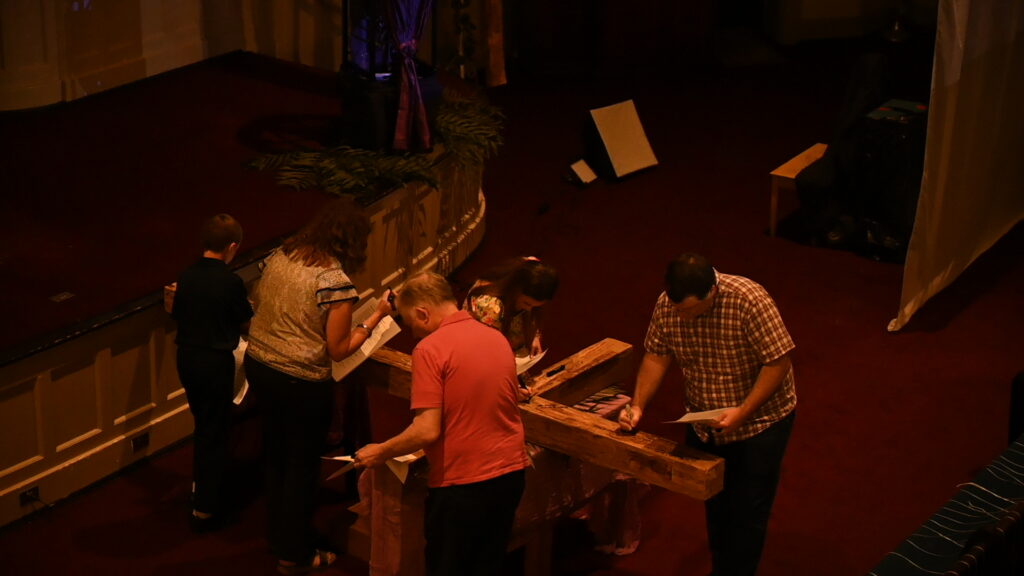
In this service, you will be invited to encounter a series of perspectives from people who stood near the suffering and death of Jesus or were drawn into its shadow. Some were disciples. Some were opponents. Some were grieving. Some were confused, afraid, complicit, or uncertain. Each encountered the cross from a different place.
You do not need to read every profile.
Instead, take your time. Remain still. Listen closely. Pay attention to where you feel drawn. You may find yourself lingering with a particular voice, a particular perspective, or a particular question. Let the Spirit guide you toward the story that meets you where you are tonight.
As you read, listen for more than similarity. Listen for what each person reveals about Jesus, about the world, and about the human heart in the presence of the cross. You may hear your own questions, your own grief, your own hopes, or your own need for grace echoed there.
We will remain in this quiet and prayerful space until just after 7:00 p.m. At that time, we invite you to stay with us as the service continues.
Mary, Mother of Jesus
Who is she? Jesus’ mother, present at the cross (John 19:25–27).
Perspective:
- She has walked with him since before his birth and now stands helpless before his death.
- Her soul aches with a pain that only a parent could know.
- Yet she is not only a grieving mother. She is also a daughter of Israel, watching God’s promise pass through agony.
- Her presence says: I will not leave you, even here.
Questions to reflect:
What might Mary be holding onto in this moment? Do you know what it is like to watch someone suffer?
Can you relate to her pain, or to her faithful presence?
What might Mary see about God’s faithfulness here, even through grief?
The Beloved Disciple (likely John)
Who is he? One of Jesus’ closest friends, standing at the cross and given care of Mary (John 19:26–27).
Perspective:
- He sees a friend dying, but also something larger unfolding.
- At the foot of the cross he receives a new family, not simply a new duty.
- Even here, as death closes in, Jesus is creating a new people bound together by love.
- His grief is interwoven with responsibility and with a call to love beyond death.
Questions to reflect:
What would it feel like to be handed someone’s deepest trust at their deathbed?
Can you relate to holding sorrow and purpose at the same time?
Where have you seen new responsibility emerge in the midst of loss?
What might this scene reveal about the kind of family Jesus is forming?
Mary Magdalene
Who is she? A devoted follower of Jesus who witnessed his death and was among the first witnesses of his resurrection (Luke 8:2; John 20).
Perspective:
- Her grief is deep, but her love is deeper.
- She stays when many others flee.
- She does not yet know resurrection is coming, but she refuses to abandon Jesus in his suffering.
- She remains as a witness, carrying the memory of this horror toward the dawn she cannot yet imagine.
Questions to reflect:
Have you ever stayed close to someone in pain or death?
What does loyalty look like in the face of loss?
What might Mary Magdalene see in Jesus that others missed?
How might steadfast love become a form of witness?
Simon Peter
Who is he? One of Jesus’ closest disciples; he denied knowing Jesus three times (Luke 22:54–62).
Perspective:
- He is crushed by shame.
- He meant to be brave, but fear overtook him.
- Now, if he watches from afar, he may be wondering: Is there still a place for me in this story?
- Yet Peter’s failure is not the end of discipleship.
- At the cross, he becomes a sign of the grace that will one day reclaim the one who fell.
Questions to reflect:
Have you ever failed someone you loved?
What does regret feel like in you?
Can Peter’s story still be your story, even in your mistakes?
Where might grace still be at work in the place of your failure?
Judas Iscariot
Who is he? The disciple who betrayed Jesus with a kiss for 30 pieces of silver (Matthew 26:14–16, 47–50).
Perspective:
- Perhaps he thought he was forcing Jesus’ hand.
- Perhaps he was disillusioned with the kind of kingdom Jesus refused to bring.
- In the end, remorse overwhelmed him, and he could not undo what had been done.
- His story is tragic: a warning about choosing our own kingdom over God’s, and about what happens when betrayal hardens into despair.
Questions to reflect:
What might drive someone to betrayal?
Have you ever wanted God to act according to your own expectations?
What happens when disappointment turns into grasping for control?
Can Judas be a warning about mistaking our kingdom for God’s?
Pontius Pilate
Who is he? The Roman governor who authorized Jesus’ crucifixion (John 19:1–16).
Perspective:
- He sees an innocent man, but political fear and crowd pressure win.
- He washes his hands, but not his conscience.
- Pilate is more than a conflicted individual; he is the face of imperial power preserving order at the expense of justice.
- He asks, “What is truth?” and then walks away from the answer standing before him.
Questions to reflect:
What does compromise cost you?
Have you ever felt stuck between what is right and what is safe?
Where do you see yourself tempted to protect order rather than pursue justice?
Do you resonate with Pilate’s hesitation, his silence, or his surrender to the system?
The Roman Centurion
Who is he? The soldier in charge of the crucifixion who later proclaimed, “Truly this man was God’s Son” (Mark 15:39).
Perspective:
- He has overseen many deaths, but something about Jesus pierces through his armor.
- Power and violence are the world he knows. Yet here, in the suffering of the crucified one, he glimpses a different kind of kingship. Even Rome’s machinery begins, however dimly, to tell the truth about Jesus.
Questions to reflect:
What might it take to change a hardened heart?
Can seeing suffering transform us?
What kind of power does the centurion encounter at the cross? Is his confession something you have felt yourself?
Barabbas
Who is he? A convicted rebel and murderer released instead of Jesus (Mark 15:6–15).
Perspective:
- He walks free while Jesus takes his place.
- He did not earn his release; it was given.
- As he disappears into the crowd, we are left to wonder whether he ever looked back.
- In his freedom we glimpse the disturbing mercy of the cross: the guilty released while the innocent bears the sentence.
Questions to reflect:
What do you do with unearned grace?
Have you ever been given a second chance you did not expect?
What does Barabbas represent to you?
How does his release change the way you see Jesus’ death?
Bartimaeus: the Healed Blind Man
Who is he? A blind beggar who was healed by Jesus near Jericho shortly before Jesus entered Jerusalem (Mark 10:46–52).
Perspective:
- He once sat in darkness by the roadside, shouting, “Jesus, Son of David, have mercy on me!”
- Now, healed and following on the way, perhaps he watches from the crowd with sight newly restored and heart still full of wonder.
- He sees clearly enough to stay near Jesus, even when the road leads into suffering.
Questions to reflect:
What has Jesus healed in you?
What do you see more clearly now?
Could your own story of mercy lead you to stay close to Jesus, even through suffering?
What kind of sight does faith require at the cross?
Nicodemus
Who is he? A Pharisee and member of the Sanhedrin who came to Jesus by night and later helped bury him (John 3:1–21; 19:39).
Perspective:
- Quiet, cautious, and curious, he once came by night.
- But when the time came, he stepped into the light.
- By bringing burial spices, he aligned himself publicly with Jesus at great personal risk.
- The man who once asked hesitant questions now performs a costly act of devotion.
Questions to reflect:
Have you ever followed Jesus in secret?
What does it mean to step into the light at the right time?
What would courage look like for you?
Where might a quiet faith be ready to become public faithfulness?
Joseph of Arimathea
Who is he? A respected council member who offered his own tomb for Jesus’ burial (Mark 15:42–46).
Perspective:
- A man of status who moved with quiet compassion.
- His gesture did not undo the crucifixion, but it gave dignity in death.
- Joseph uses public standing and material resources to honor Jesus when doing so could cost him dearly.
- His courage is measured, visible, and concrete.
Questions to reflect:
When have you been called to use your resources for someone else’s sake?
Can you relate to loving Jesus through a quiet, tangible act?
How might privilege or position become an instrument of faithfulness?
What does dignity in death reveal about love?
Mary of Bethany
Who is she? The sister of Martha and Lazarus, a beloved friend of Jesus. Days before the crucifixion, she anointed Jesus’ feet with perfume (John 12:1–8).
Perspective:
- She knelt in love, pouring out what others called waste, but Jesus called beautiful.
- She may not have understood everything, but she recognized that something sacred and costly was unfolding.
- Long before the cross, she honored him as one destined for burial, offering prophetic love when others could not yet bear the truth.
Questions to reflect:
Have you ever acted in love when others did not understand?
What does it mean to offer something costly to Jesus?
Could Mary’s quiet devotion echo your own?
How might love sometimes perceive what reason is slow to admit?
The Crowd that Cried “Crucify”
Who are they? A gathering of people, locals, pilgrims, neighbors, assembled during Passover, caught in the tension between empire and expectation (Mark 15:13–14).
Perspective:
- The crowd is not one person.
- It is a mix of voices, some loud, some quiet, some unsure, some swept along.
- It is the place where disappointed hopes, political pressure, fear, and social contagion collide.
- The Disillusioned Follower: “I believed he was the one. But nothing happened. Maybe I was wrong.”
- The Fearful Observer: “I did not mean to join in. I just did not speak up.”
- The Zealot Sympathizer: “Barabbas might fight. Jesus did not.”
- The Regretful Voice: “I shouted too. But now I wish I had not.”
- And then, there is a fifth voice.
_____________________________: What were you feeling? What did you see? What did you want?
Questions to reflect:
Do you see yourself in any of these voices?
Can you name your place in the crowd, not in shame, but in honesty?
What voice might still need to be heard?
How do disappointment, fear, or the pull of the crowd shape what we ask of Jesus?
Simon of Cyrene
Who is he? A traveler from North Africa who was forced to carry Jesus’ cross (Mark 15:21).
Perspective:
- He did not plan to be involved.
- But suddenly, he was bearing the burden of another’s suffering, sharing the weight of the condemned king.
- Perhaps something shifted in him that day and he never looked away again.
- What began as coercion may have become a strange form of discipleship?
Questions to reflect:
Have you ever been drawn into someone’s pain unexpectedly?
What burdens have you carried that changed you? Could this be a holy interruption?
What might it mean to share the burden of the crucified one?
Thaddaeus (also called Judas son of James)
Who is he? One of the Twelve disciples (Luke 6:16; Acts 1:13), often overlooked and quietly faithful.
Perspective:
- He followed Jesus closely, left much behind, witnessed miracles, and heard every parable, yet Scripture says little about him.
- Perhaps he stood at a distance, quietly grieving, holding his questions in silence.
- Sometimes faith is steady and unseen, not dramatic but enduring.
Questions to reflect:
Do you ever feel like your part in the story is small or hidden?
What does it mean to follow faithfully without recognition?
Could Thaddaeus give voice to your quiet discipleship?
Where might unseen faithfulness matter more than public notice?
Thomas (also called Didymus)
Who is he? One of the Twelve, remembered for both his doubt and his devotion. When Jesus spoke of returning to Judea, Thomas said, “Let us also go, that we may die with him” (John 11:16).
Perspective:
- Not long ago, he had spoken bravely, ready to face death alongside his teacher. Now, he watches Jesus die alone.
- Perhaps he wonders why the others fled?
- Perhaps he wonders whether courage was ever enough?
- Later, he will wrestle with resurrection, but perhaps only because he had loved so deeply and could not pretend that hope comes cheaply.
Questions to reflect:
Have you ever tried to be brave and ended up broken?
What does loyalty look like in the face of loss?
Can you relate to a heart that dares to hope even through doubt?
How might deep love make honest questions unavoidable?
The Servant Girl (Peter’s Accuser)
Who is she? A bystander in the courtyard who recognized Peter as one of Jesus’ followers (Luke 22:56–57).
Perspective:
- Young, observant, and perhaps simply telling the truth, she names what others are trying to hide.
- In a world that overlooks people like her, she sees clearly enough to expose Peter’s fear.
- Her words do not create his denial, but they reveal it.
Questions to reflect:
Have you ever named something others were afraid to say?
Can you relate to being dismissed, or to being the one who sees clearly?
What truth might a socially overlooked person perceive before others do?
How do uncomfortable truths bring hidden loyalties into the light?
The Temple Guard
Who is he? One of the men who arrested Jesus in the garden of Gethsemane (John 18:3).
Perspective:
- Trained to follow orders, he comes prepared for resistance.
- But this prisoner is different: no violent defense, no scrambling escape, only a strange authority and peace.
- Perhaps he wonders still what kind of man heals an enemy in the middle of arrest?
- Jesus unsettles the script by refusing to play the game of force.
Questions to reflect:
Have you ever followed a script without asking questions?
What might Jesus’ way of peace stir in someone trained for control?
Where have you mistaken obedience for righteousness?
What happens when true authority looks nothing like coercion?
Cleopas (on the Road to Emmaus)
Who is he? One of two disciples who encountered the risen Jesus on the road, though they did not recognize him at first (Luke 24:13–35).
Perspective:
- He is walking away from Jerusalem, disappointed, confused, and grieving.
- He thought Jesus was the one. Yet even in retreat, hope walks beside him in disguise.
- Cleopas carries the sorrow of Good Friday into the slow surprise of Easter, learning that despair does not have the last word.
Questions to reflect:
Have you ever felt like walking away?
What does it mean to carry disappointment with God?
Could resurrection be unfolding even if you do not yet see it?
How might hope accompany you before you know its name?
HEADLINES
Beginning close to home: Richmond
Hoodship Unity Basketball Game held in an effort to help stop gun violence
Richmond gas prices reach $4 a gallon
Missing Hopewell teen found dead in Caroline County
Richmond to resume Operation Vaporize enforcement on vape shops
Housing advocates push for more duplexes in Richmond’s ‘Code Refresh’
Lanes reopen after multi-vehicle crash on I-95 north in Chesterfield
Community builds ramp for 2-year-old who lost foot in lawn mower accident
Man suffers life-threatening injuries in Petersburg shooting, police say
Traffic signals near VCU flipped in favor of students: ‘It made me nervous’
Chesterfield Police clock two drivers going 40+ over limit in traffic blitz
All lanes reopen after crash into power lines on Mechanicsville Turnpike
Henrico police say driver hit pedestrian on Nine Mile Road
$780K pedestrian safety project planned around Richmond elementary school
Inside Richmond’s ‘Spring Forward’ initiative to keep students safe and engaged
Investigators share update after body found in woods: ‘Sick and Deliberate’
Memorial grows where three high school seniors were killed in Virginia crash
VDH staff first said no to new Chesterfield hospital. Why commissioner said yes.
Colonial Heights under boil water advisory after 50-year-old water main ruptures
Flights halted at 5 airports, including RIC, over smell at air traffic center
‘No Kings’ crowd marches in Richmond: ‘So many things going on’
Pulling back across the Commonwealth: Virginia
Gov. Spanberger signs first batch of bills into Virginia law
Virginia legislation creates new rules for tobacco and vape shops
‘We are not enforcing’: Email details Virginia nursing home oversight gap
Spanberger orders Virginia’s return to ERIC voter data partnership
Aircraft carrier USS George HW Bush, 4,000 sailors leave Norfolk
Spanberger considering assault weapons ban, other gun restrictions
General Assembly sends slate of immigration bills to Spanberger’s desk
Spanberger to consider legislation requiring state guidance on AI in schools
Spanberger calls April 23 special session to finalize state budget
Medical malpractice in Virginia was nearly overhauled. What happened?
Hanover utility director presents short-term water enhancements
Henrico County continues its ‘course of progress’ in FY27 budget proposal
Judge finds Virginia Democrats’ redistricting resolution illegal
Charlottesville works to tackle both angles of local housing need
Widening the frame: the United States
Supreme Court justices skeptical of Trump order to restrict birthright citizenship
US retail sales strong in February; rising gasoline prices will hurt spending
Luigi Mangione’s continued support shows need for swift trial, prosecutor says
Lilly’s weight-loss pill wins US approval, sets up next battle with rival Novo Nordisk
Trump administration cannot alter homelessness funding conditions, US court rules
US Congress to pass bills to fully fund Homeland Security, Republican leaders say
Death of near-blind refugee in New York ruled a homicide
Exclusive: US nicotine pouch fast-track scheme slowed by worries over youth, new users
US traffic deaths fall to lowest number since 2019
Exclusive: Pfizer, BioNTech halt US COVID vaccine study after recruitment struggles
As Trump weighs appeal of vaccine ruling, Kennedy supporters push for fight
US Senate aims to pass Homeland Security bill Thursday to end shutdown, source says
In historic first, Trump attends Supreme Court arguments
U.S. Justice Department sues Idaho for failure to produce voter rolls
NASA counts down for first crewed lunar mission in half a century
A New York vintner raids US wine cellars to skirt Trump’s tariffs
US farmers to plant less corn as Iran war spikes fertilizer prices
Exclusive: Fed’s Barkin says households, firms still see oil shock through a “short-term lens”
Judge orders Trump to halt $400 million White House ballroom project, for now
US State Department settles lawsuit claiming Biden-era suppression of conservative news
Judicial panel in Wisconsin dismisses lawsuit challenging state’s congressional map
Trump admin presents new plan to slash two thirds of consumer watchdog workforce
Trump administration prepares final lending rule to narrow civil rights protections
Judge throws out US Justice Department lawsuit challenging sanctuary laws in Colorado, Denver
Appeals court pauses orders restricting federal officers’ use of tear gas at Portland ICE building
‘No Kings’ rallies draw crowds across US, in Europe. Springsteen headlines Minnesota demonstration
Dozens arrested for failing to disperse after ‘No Kings’ rally in Los Angeles
Minnesota to host ‘No Kings’ flagship rally, headlining Springsteen amid tensions over ICE and war
A federal judge orders better attorney access at Florida’s ‘Alligator Alcatraz’
ICE leader defends officers before Congress after deaths of two people in Minnesota
Judge rules US government overreached with transgender health care declaration
Federal authorities announce end to Minnesota immigration crackdown that led to mass detentions, protests and two deaths
Mexican immigrant died in US immigration custody, ICE says, marking 14 deaths in 2026
Exclusive: Trump’s approval hits new 36% low as fuel prices surge amid Iran war, Reuters/Ipsos poll finds
Federal judge finds Trump violated free speech by ordering NPR defunded
Finally, pulling all the way back: Spanning the Globe
Trump says US may exit Iran war soon and threatens to quit NATO
Zelenskiy, Rutte hold talks with US negotiators, source says
A war meant to break Iran could leave Tehran stronger, and Gulf exposed
IEA, IMF and World Bank to coordinate response to Middle East war’s impact
France tells US NATO serves Euro-Atlantic security, not Hormuz offensive missions
Pakistan, Afghanistan open fresh talks in China to end conflict, say sources
Russia says its troops have taken full control of Luhansk region in eastern Ukraine
New Zealand, Cook Islands sign Defense and Security Declaration
Burundi says 13 killed in explosion at military ammunition depot
South African farmers grapple with rising diesel costs as harvest season approaches
Kenya tea exports hit by Iran conflict as stocks pile up
Fuel prices surge in Africa as Iran war hits supply
South Africa tax collection up 8% last fiscal year, preliminary data shows
Coca-Cola plans to invest $1 billion in South Africa through 2030
Ghana’s inflation slows for 15th straight month in March
US firm Virtus launches Chemaf transition in Congo mining partnership
Spanish police bust underground hashish route from Morocco
South African factory mood bleak in March as Iran war pressures start to build
South African citrus growers forecast another record year for exports
Switzerland says cancelling U.S. Patriot missile system order an option
Hungary’s far-right party seen as potential kingmaker in April 12 election
Hungary election polls show opposition Tisza widening lead over Orban’s Fidesz
Ukraine’s military hits Russian missile components plant in Bryansk region
Bulgaria’s caretaker PM says elections will be cleanest in years
Italian bill offers incentives for fishing nets to shield Ukraine from drones
Trump threatens NATO exit, scaling up tensions with allies
France suspects link to pro-Iranian group in foiled BofA Paris plot
Russia launches rare daytime drone attack on Ukraine, killing four, Ukrainian officials say
Swiss finance minister sues for defamation over Grok-created post
Factory input costs soar worldwide as Iran war snarls up supply chains
UK police arrest three more men over arson attack on Jewish community ambulances
London mayor asks diplomats to push back against Trump’s ‘lies’ about UK capital
Serbian students, protesters clash with police in Belgrade
North Korea-linked hack hits largely invisible software that powers online services
Fifteen deaths are confirmed after measles outbreak in Bangladesh
Corruption probe against former Kyrgyz security chief widens with arrest of his brother
EU lawmakers press China on unsafe products on rare Beijing visit
Australian leader urges using public transport, says war’s effects will last months
French peacekeeping troops in Lebanon subject to ‘unacceptable intimidation’ -junior minister
Accused money laundering leader extradited from Cambodia to China
Look at Hong Kong and don’t be naive about China, US senator says on Taiwan trip
Brazil enlists bank managers to combat deforestation
US exempts Gulf of Mexico drillers from endangered species rules
California AI order requires firms seeking state contracts to have safeguards against abuse
Australia readies social media court action citing teen ban breaches
EU lawmakers vote to make it easier to set up migrant detention centers outside the bloc
Iran war chokes aid corridors, obstructing global relief efforts